- Like
- Digg
- Del
- Tumblr
- VKontakte
- Buffer
- Love This
- Odnoklassniki
- Meneame
- Blogger
- Amazon
- Yahoo Mail
- Gmail
- AOL
- Newsvine
- HackerNews
- Evernote
- MySpace
- Mail.ru
- Viadeo
- Line
- Comments
- Yummly
- SMS
- Viber
- Telegram
- Subscribe
- Skype
- Facebook Messenger
- Kakao
- LiveJournal
- Yammer
- Edgar
- Fintel
- Mix
- Instapaper
- Copy Link
Purpose:
To teach players the correct way to deny a wing entry pass.
Setup:
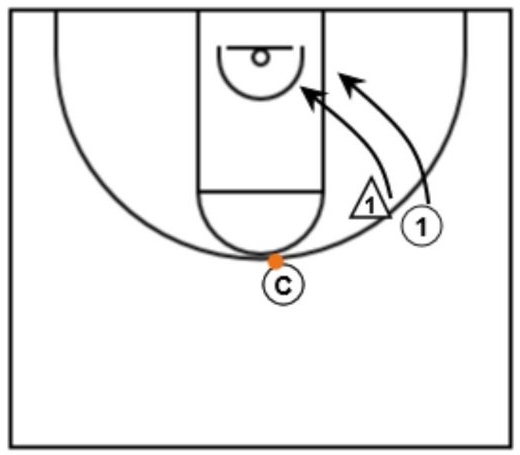
Coach stands at the top of the arc, offensive player begins on wing with a ball, defensive players form a line under the hoop. Diagram 1: Defensive player denying the backdoor cut.
Execution:
- Offensive player begins the drill by passing the ball to the coach at the top of the arc.
- The defender will sprint out from the paint and get into denial position.
- The defender should have their high arm out in denial in the passing lane, using their peripheral vision to keep an eye on both the ball and their defender.
- The offensive player will attempt to get open, using backdoors and v-cuts to try and separate from the defender and receive the pass.
- The defender must deny the pass for 35 seconds to receive a point.
- After each rep, defense switches to offense and offense goes to the back of the line.
- Continue drill until each player has had a minimum of 2 reps.
Coaching Tips
• We will deny the pass anywhere – except way deep off the three-point line. If the defender wants to go 2-3 feet off the 3-point line (in-game) to receive the pass, we will let them. For the purposes of the drill, however, the coach won’t make that pass.
For Younger Athletes:
- Emphasize proper defensive stance: Encourage younger players to bend their knees, keep their feet shoulder-width apart, and stay low to the ground to maintain balance and agility.
- Teach active hands: Guide younger athletes to keep their hands up and active in the passing lane to disrupt the pass and make it more difficult for the offensive player to find an open passing lane.
- Simplify communication: Younger players may struggle with complex defensive strategies, so focus on basic communication cues such as “ball,” “deny,” and “help” to help them understand their defensive responsibilities.
For Older Athletes:
- Master timing and anticipation: Challenge older players to anticipate the offensive player’s movements and passes by reading their body language and reacting quickly to intercept or deflect the ball.
- Refine footwork: Encourage older athletes to work on their footwork to maintain proper positioning while denying the pass, including shuffling quickly to cut off passing lanes and recovering effectively if beaten.
- Develop situational awareness: Help older players develop a deeper understanding of game situations and opponent tendencies, enabling them to make smarter decisions and anticipate plays before they happen.
- Like
- Digg
- Del
- Tumblr
- VKontakte
- Buffer
- Love This
- Odnoklassniki
- Meneame
- Blogger
- Amazon
- Yahoo Mail
- Gmail
- AOL
- Newsvine
- HackerNews
- Evernote
- MySpace
- Mail.ru
- Viadeo
- Line
- Comments
- Yummly
- SMS
- Viber
- Telegram
- Subscribe
- Skype
- Facebook Messenger
- Kakao
- LiveJournal
- Yammer
- Edgar
- Fintel
- Mix
- Instapaper
- Copy Link